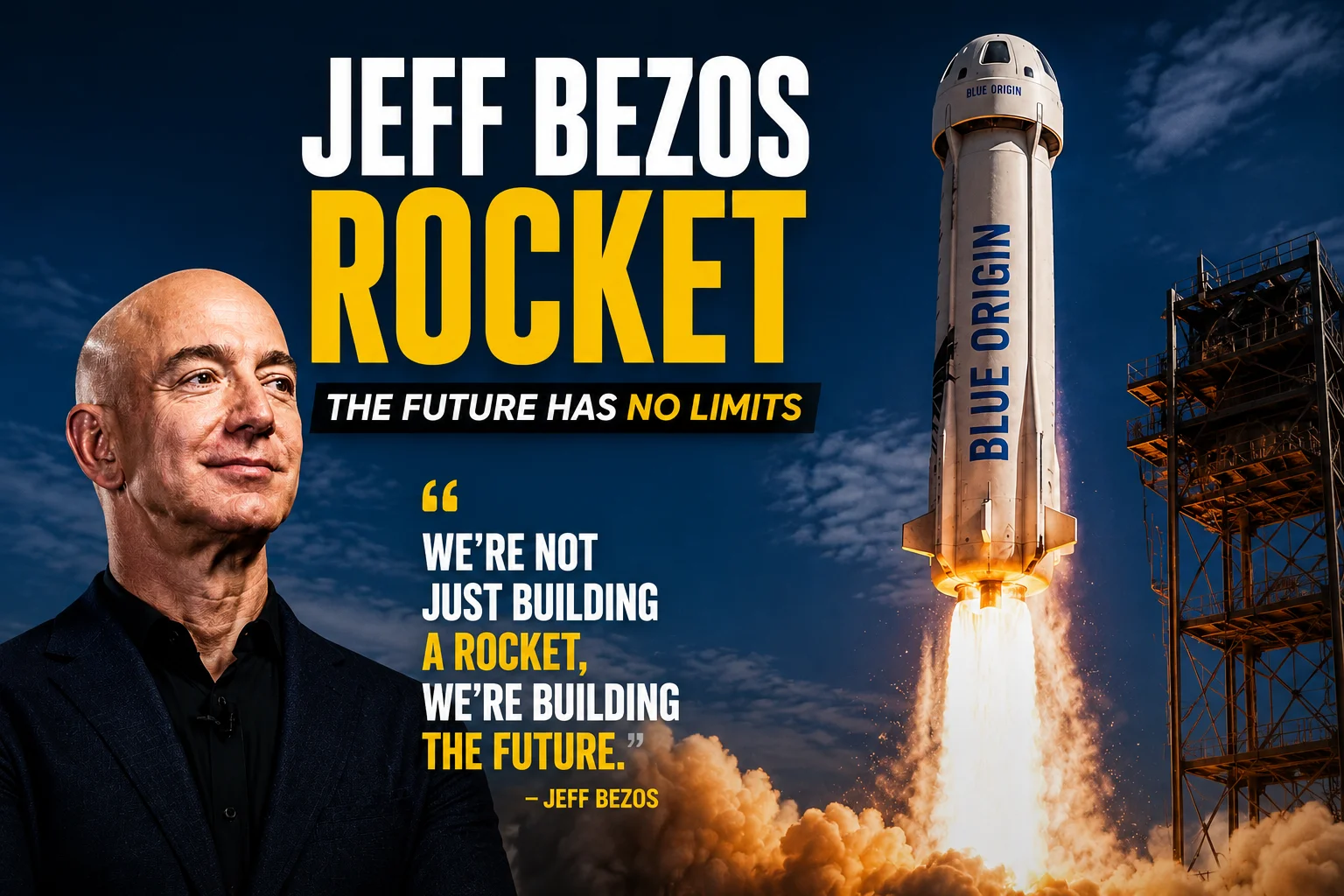
Jeff Bezos rocket has become one of the most talked-about topics in modern space exploration. Many people want to understand how the rocket works, why it was built, and what it means for the future of space travel. Jeff Bezos created Blue Origin with a long-term goal of making space more accessible for people and businesses. Unlike traditional government programs, Blue Origin focuses on reusable rocket technology that lowers costs and supports regular launches. Today, the company continues testing new systems while expanding commercial opportunities. Understanding this project helps explain how private companies are changing the future of space exploration.
Who is Jeff Bezos? A brief biography
| Field | Information |
|---|---|
| Full Name | Jeffrey Preston Bezos |
| Known As | Jeff Bezos |
| Date of Birth | January 12, 1964 |
| Age | 62 (as of 2026) |
| Birthplace | Albuquerque, New Mexico, United States |
| Nationality | American |
| Profession | Businessman, Entrepreneur, Investor, Media Proprietor |
| Education | Princeton University (B.S.E. in Electrical Engineering and Computer Science) |
| Famous For | Founder of Amazon, Founder of Blue Origin, Owner of The Washington Post |
| Current Position | Executive Chairman of Amazon |
| Years Active | 1986–present |
| Marital Status | Married |
| Spouse | Lauren Sánchez (married 2025); previously married to MacKenzie Scott (1993–2019) |
| Children | 4 |
| Notable Companies | Amazon, Blue Origin |
| Major Achievements | Founded Amazon in 1994, created Blue Origin in 2000, among the world’s wealthiest entrepreneurs, established the Bezos Earth Fund and Bezos Day One Fund. |
| Net Worth | Frequently ranked among the world’s richest people; net worth changes with market value. |
What Is the Jeff Bezos Rocket?
The Jeff Bezos rocket is mainly known as New Shepard, a reusable suborbital rocket developed by Blue Origin. It carries scientific experiments and passengers above the Kármán line, which is widely accepted as the boundary of space. After reaching its highest point, the crew capsule safely returns using parachutes, while the booster lands vertically for reuse. This innovative design reduces waste and operating costs. Because of its reusable technology, New Shepard has become an important example of modern commercial spaceflight and has inspired greater public interest in private space exploration.
Blue Origin also develops larger launch systems, including the powerful New Glenn rocket for orbital missions. While New Shepard focuses on tourism and research, New Glenn is designed to carry satellites and heavy payloads into orbit. These different rockets demonstrate Blue Origin’s broader vision for supporting scientific discoveries, commercial services, and future human exploration. Readers interested in reusable launch systems may also enjoy related content about Blue Origin technology and commercial spaceflight history. Together, these topics explain how modern rockets continue transforming access to space through advanced engineering and long-term innovation. Read More : Ceasefire: Meaning, Types, Importance, and Global Impact
Why Jeff Bezos Started Blue Origin
Jeff Bezos founded Blue Origin because he believes millions of people could eventually live and work in space. His long-term vision extends far beyond tourism. Instead, he wants heavy industries to move into space while Earth remains cleaner and better protected. Building reusable rockets is one important step toward achieving that ambitious goal. Developing reliable transportation systems creates opportunities for scientists, businesses, and future explorers. Although this vision may take decades, Blue Origin continues investing in research, testing, and engineering to make regular space travel more practical and affordable over time.
Unlike many traditional aerospace programs, Blue Origin follows the motto “Gradatim Ferociter,” meaning “Step by Step, Ferociously.” This philosophy encourages careful testing before moving to larger projects. Rather than rushing launches, engineers improve systems through repeated trials and detailed analysis. That patient approach has helped create reliable reusable rocket technology while reducing operational risks. People searching for information about the future of space exploration or private space companies often discover how Blue Origin’s steady development strategy differs from competitors. The company believes consistent progress creates stronger foundations for future missions beyond Earth.
How the Jeff Bezos Rocket Works
The Jeff Bezos rocket uses advanced reusable technology that allows both the booster and crew capsule to return safely after each mission. During launch, powerful engines lift the rocket toward space before the booster separates from the capsule. The capsule continues climbing briefly before passengers experience several minutes of weightlessness. Meanwhile, the booster carefully guides itself back using onboard computers and precision landing systems. Finally, the capsule descends with large parachutes, providing a smooth landing. This entire process demonstrates how reusable rockets reduce costs while increasing launch efficiency for future missions.
Safety remains one of the most important priorities throughout every launch sequence. Blue Origin performs extensive testing before flights and continuously monitors rocket systems during each mission. Multiple backup systems protect passengers if unexpected situations occur during launch or descent. Escape mechanisms can quickly separate the crew capsule from the booster if necessary. Engineers also inspect every reusable component before another launch takes place. Readers interested in rocket safety systems or spaceflight engineering can better understand why thorough preparation remains essential for successful commercial space missions using reusable technology.
Space Tourism and Passenger Experience
One major purpose of the Jeff Bezos rocket is providing commercial space tourism experiences. Selected passengers complete training before launch, learning safety procedures and understanding what to expect during the flight. After liftoff, the rocket accelerates rapidly before reaching the edge of space. Passengers then unbuckle briefly to float inside the capsule and enjoy breathtaking views of Earth through large windows. Although the experience lasts only several minutes in space, many travelers describe it as unforgettable. The mission concludes with a gentle parachute landing back on Earth.
Space tourism remains expensive today, making it available to relatively few people. However, supporters believe reusable technology will gradually reduce costs as launch frequency increases. Similar progress occurred in commercial aviation, where improved technology eventually made flying more affordable. Scientists also benefit because research payloads can travel alongside passengers during certain missions. This combination of tourism and scientific research creates additional value for each launch. As commercial spaceflight continues developing, more opportunities may become available for education, technology testing, and future space travelers worldwide.
Technology Behind Blue Origin Rockets
Blue Origin invests heavily in advanced rocket engines, reusable systems, and modern manufacturing methods. One important achievement is the BE-3 engine used by New Shepard, which provides reliable performance during launch and landing. The company also develops powerful engines for larger orbital rockets and future exploration projects. Engineers constantly improve materials, software, and flight control systems to increase safety and efficiency. These technological advancements help reduce operational costs while supporting more frequent launches. Continuous innovation remains essential because space missions demand precision, reliability, and exceptional engineering standards.
Modern reusable rockets rely on advanced computers that make thousands of calculations during every flight. These systems monitor fuel, engine performance, speed, altitude, and landing conditions in real time. Artificial intelligence and automation also support decision-making throughout complex launch operations. Engineers analyze detailed flight data after every mission to improve future performance. This careful learning process strengthens reliability while reducing unnecessary risks. Readers exploring rocket engine technology or reusable spacecraft innovations can better appreciate the engineering efforts required to make commercial spaceflight increasingly dependable and successful.
Impact on the Space Industry
The Jeff Bezos rocket has encouraged greater competition within the private space industry. Multiple companies now invest in reusable launch systems, creating faster technological progress and expanding commercial opportunities. Increased competition often leads to lower launch costs, improved reliability, and more innovation. Governments, universities, and private organizations benefit because they gain additional launch options for satellites and scientific research. As more companies participate, the entire industry becomes stronger through shared technological advances and growing market demand for commercial space services around the world.
Private investment has also changed public interest in space exploration. Millions of people now follow rocket launches online, inspiring students to learn more about science, engineering, and technology careers. Educational programs frequently use commercial missions as examples of real-world innovation and teamwork. Businesses continue exploring new opportunities involving satellite communications, Earth observation, manufacturing, and research. Although challenges remain, the growth of commercial spaceflight demonstrates how collaboration between private companies and public organizations can accelerate technological development while expanding humanity’s presence beyond Earth.
Future Plans for the Jeff Bezos Rocket
Blue Origin continues developing larger rockets and long-term space infrastructure beyond current tourism missions. The company’s New Glenn rocket is expected to support satellite deployment, scientific missions, and commercial launches into orbit. Engineers also study technologies that could support lunar exploration and future space habitats. These projects require years of research, testing, and international cooperation. However, each successful mission builds valuable experience for larger goals. Long-term planning remains important because reliable transportation systems form the foundation for future exploration beyond Earth’s atmosphere.
Looking ahead, reusable rocket technology will likely become even more efficient and cost-effective. Better engines, lighter materials, and smarter software could increase launch frequency while improving safety. More research institutions may gain affordable access to space, encouraging scientific discoveries across many fields. Businesses could develop entirely new services that depend on regular launches. Although predicting the future is difficult, continued innovation suggests commercial spaceflight will play an increasingly important role in exploration, research, education, and global technological progress during the coming decades.
Frequently Asked Questions
1. What is the Jeff Bezos rocket called?
The most famous Jeff Bezos rocket is New Shepard, developed by Blue Origin. It is a reusable suborbital rocket designed for space tourism, research missions, and technology testing above the edge of space before returning safely to Earth.
2. Did Jeff Bezos travel on his own rocket?
Yes. Jeff Bezos flew aboard the first crewed New Shepard mission in July 2021. The successful flight demonstrated Blue Origin’s reusable space tourism system and marked an important milestone for the company.
3. Is the Jeff Bezos rocket reusable?
Yes. Both the New Shepard booster and crew capsule are designed for reuse. The booster lands vertically, while the capsule returns using parachutes, helping reduce launch costs and improve operational efficiency.
4. What is the purpose of Blue Origin?
Blue Origin aims to make space travel more accessible through reusable rockets. The company supports scientific research, commercial launches, and long-term plans for expanding human activities beyond Earth while protecting our planet.
5. How high does the Jeff Bezos rocket fly?
New Shepard flies above the Kármán line, approximately 100 kilometers or 62 miles above Earth. This altitude allows passengers to experience weightlessness and view Earth from space before returning safely.
Conclusion
The Jeff Bezos rocket represents an important step in the evolution of commercial space exploration. Through reusable technology, Blue Origin continues improving launch efficiency, supporting scientific research, and expanding opportunities for future space travel. While challenges remain, the company’s steady approach demonstrates how innovation can reshape the aerospace industry over time. As technology advances, reusable rockets may become more affordable, reliable, and widely available. If you want to learn more, continue exploring topics like Blue Origin missions, reusable rocket technology, and the future of commercial spaceflight to better understand this exciting journey into space.